










CB radio FAQ
One or two sentences each. When an answer needs more room, it links to the full guide.
Radio Controls
Learn what each control on your CB radio does and how to set it properly
What is the squelch control on a CB radio?
The squelch control filters out background static when no one is transmitting. Turn it clockwise until the static just disappears - this is the optimal setting. If set too high, you may miss weak signals. If set too low, you'll hear constant static.
How do I set the RF gain on my CB radio?
RF Gain controls receiver sensitivity. For most situations, set it to maximum. In heavy traffic or with strong nearby stations, reduce it to prevent distortion. Start at max and adjust down if signals sound overdriven.
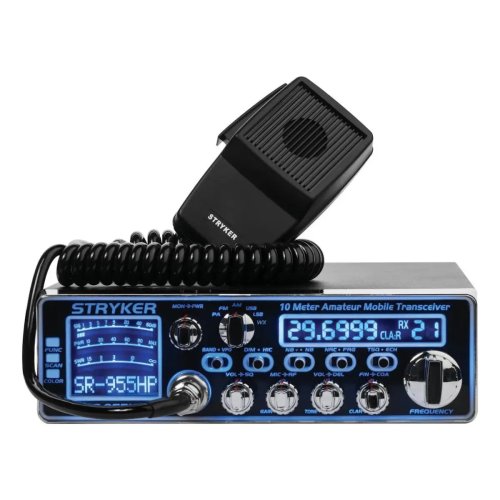
How do I adjust the echo on my Stryker radio?
Echo controls are typically on the front panel or inside the radio. For Stryker radios: 1) Locate the ECHO knob, 2) Turn it to about 25-30% for a natural sound, 3) Avoid setting it too high as it can cause feedback and make your audio unintelligible. Some radios have internal adjustment pots for fine-tuning.
What is the Delta Tune or Clarifier?
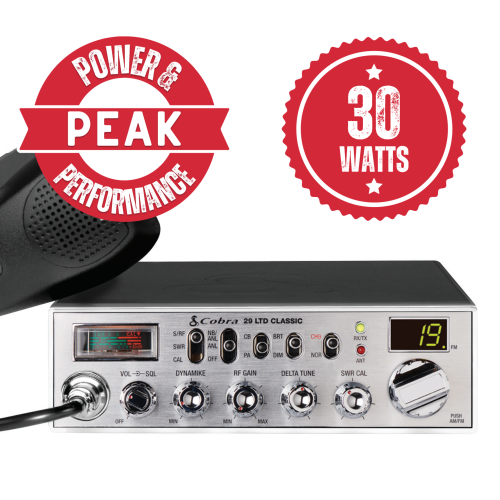
The Delta Tune (also called Clarifier) fine-tunes receive frequency. On AM, it's mainly used to center signals. On SSB (Single Sideband), it's essential for making voices sound natural. Adjust until the other station sounds clear and not 'Donald Duck' like.
Why do voices sound distorted or robotic on SSB?
SSB does not lock exactly on frequency like AM. Voices sound distorted when the radio is slightly off frequency. Use the clarifier (delta tune) knob and slowly adjust until the voice sounds natural. This is normal and required every time you change channels or talk to a different station.
What is the weather alert feature on a CB radio?
The weather alert feature monitors NOAA weather channels in the background. If a severe weather alert is issued, the radio will automatically notify you or switch to the weather channel. This feature is useful for travel and outdoor use but can be turned off if alerts are not desired.
Why would I use an external speaker with my CB radio?
An external speaker improves audio clarity and volume, especially in noisy vehicles. It allows you to position the speaker closer to your ears and often sounds clearer than the small built-in speaker inside the radio.
How do I use the CAL knob on a Cobra CB radio?
To use the CAL knob: set the meter switch to CAL, key the microphone, and turn the CAL knob until the needle reaches the CAL mark. Without releasing the mic, switch the meter to SWR and read the value. The CAL knob only calibrates the meter; it does not tune the antenna.
What does auto calibrate mean on a CB radio?
Auto calibration means the radio electronically calibrates the SWR meter for you. No CAL knob or manual adjustment is required. Simply switch the meter to SWR or key the microphone, and the radio displays the SWR reading automatically.
Why do truckers install echo on CB radios?
Echo is often used to make a radio sound louder and fuller, helping audio stand out in noisy environments. While not required for communication, some operators prefer echo for personal audio style. Excessive echo can reduce clarity.
What does the delta tune do on a CB radio?
Delta Tune, also called the clarifier, fine-tunes the receive frequency. It is mainly used on SSB to make voices sound natural and clear. On AM, it is rarely needed.
What is a noise-canceling microphone and how do I use it?
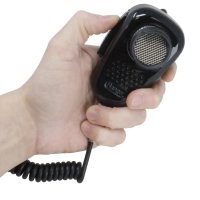
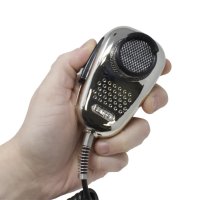
Noise-canceling microphones reduce background noise by focusing on sound very close to the mic element. To use one correctly, speak very close to the microphone—often called "eating the mic." Speaking too far away will result in weak or muffled audio.
What do band letters on 10 meter radios do?
Band letters on 10 meter radios allow you to move through frequency ranges using a channel-and-band system instead of tuning each frequency manually. Each band represents a block of frequencies, making navigation faster and simpler.
Installation Guides
Step-by-step guides for installing CB radios, antennas, and accessories
What is a ground plane for a CB antenna?
A ground plane is the metal surface under a CB antenna that helps it transmit efficiently. On vehicles, the metal body acts as the ground plane. Poor grounding can cause high SWR and weak performance. Some antennas are designed as 'no ground plane' (NGP) for fiberglass or non-metal vehicles.
Where can I mount a CB antenna on a Peterbilt 579?
The Peterbilt 579 can be equipped with several antenna mounting locations depending on configuration. Common locations include a hood-mounted bracket on the driver’s side, mounts above the door, and mounts behind the cab. The best peforming location is the hood mount which provides a sufficient ground plane. If mounted on the cab above the door, or behind the cab, you should expect poor CB performance.
How close can CB antennas be to each other in a co-phase system?
In a co-phase (dual antenna) system, antennas are typically spaced 8 to 9 feet apart to properly shape the radiation pattern. Spacing them too close causes the antennas to interact negatively, increasing SWR and reducing performance. Proper spacing is critical for co-phase systems to work as intended.
Why do some CB and 10 meter radios need large power wires?
Power wire size is determined by how much current the radio draws and how far the wire runs to the battery. Radios over 300 watts typically require #4 AWG wire at 20 feet or less. Radios over 200 watts usually require at least #8 AWG. Radios in the 50–100 watt range are best served with #10 AWG or thicker. Lower-power radios generally work well with #10–12 AWG wire.
Why do some CB and 10 meter radios need large power wires?
Power wire size is determined by how much current the radio draws and how far the wire runs to the battery. Radios over 300 watts typically require #4 AWG wire at 20 feet or less. Radios over 200 watts usually require at least #8 AWG. Radios in the 50–100 watt range are best served with #10 AWG or thicker. Lower-power radios generally work well with #10–12 AWG wire.
Troubleshooting
Diagnose and fix common CB radio problems
Why can't I receive any signals on my CB radio?
Check these in order: 1) Squelch set too high - turn counterclockwise, 2) Volume turned up? 3) Antenna properly connected? 4) Are you on an active channel (19 is most popular)? 5) Try both AM and SSB modes if available. 6) Check antenna SWR - high SWR can affect receive.
My CB radio doesn't transmit
Troubleshooting steps: 1) Check microphone connection - fully seated? 2) Try a different microphone if available, 3) Check SWR - high SWR can prevent transmission, 4) Verify antenna connection, 5) Check power - some radios need 13.8V for full power, 6) Some radios have a TX disable switch.
How do I turn on my Stryker 655 or 955?
Turn the VOL knob on the bottom left. Do NOT turn the RF PWR / MON knob in the top left - these controls are for different functions.
Why does SWR change when I move my antenna?
SWR changes because the antenna interacts with nearby metal, wiring, and the vehicle body. Moving the antenna changes its electrical environment. Even small changes in location or mounting can affect SWR, which is why SWR should always be rechecked after repositioning an antenna.
How do I tune a cut-to-tune CB antenna?
Cut-to-tune fiberglass antennas are tuned by shortening the antenna in small increments. Start with the antenna uncut. Check SWR on channels 1 and 40. If channel 40 is higher, carefully cut 1/8 to 1/4 inch from the top of the antenna. Recheck SWR after each cut. Never cut too much at once, as material cannot be added back.
How do I tune a tunable-tip CB antenna?
Tunable-tip antennas use an adjustable metal tip or screw to change antenna length. To tune, check SWR on channels 1 and 40. If channel 40 is higher, raise the tip to shorten the antenna electrically. If channel 1 is higher, lower the tip to lengthen it. Make small adjustments and recheck SWR each time.
How do I tune a whip or stinger CB antenna?
Whip-style antennas are tuned by trimming the steel whip (stinger). Check SWR on channels 1 and 40. If channel 40 is higher, the antenna is too long and the whip must be shortened. Remove the whip and cut no more than 1/4 inch at a time using bolt cutters. Reinstall and recheck SWR after each cut.
What do I do if my SWR is higher on channel 1?
If SWR is higher on channel 1 than channel 40, the antenna is too short. Lengthen the antenna by raising a tunable tip, lowering an adjustment ring, or replacing a trimmed section if possible. For cut-to-tune antennas, this usually means the antenna has been cut too much.
What do I do if my SWR is higher on channel 40?
If SWR is higher on channel 40 than channel 1, the antenna is too long. Shorten the antenna by trimming a whip, lowering a tunable tip, or adjusting tuning rings. Make small changes and recheck SWR after each adjustment.
What does E4 mean on a Stryker 447?
E4 on a Stryker 447 is a high SWR warning. It triggers when the radio detects a VSWR of approximately 3.0:1 or higher. This protection is software-controlled and is designed to prevent damage to the radio’s output transistors. If E4 appears, stop transmitting and correct the antenna or SWR issue.
How do I set my SWR?
To set SWR, take readings on channels 1, 20, and 40. If SWR is higher on channel 40 than channel 1, the antenna is too long and must be lowered or shortened. If SWR is higher on channel 1 than channel 40, the antenna is too short and must be raised or lengthened. If channel 1 and 40 read the same, the antenna is properly tuned. A good SWR is 1.5:1 or less. Readings above 2.0:1 should be corrected, as high SWR can damage your radio.
Why does my CB radio have static?
Some static on a CB radio is normal and comes from natural atmospheric noise and distant radio signals. Excessive static can be caused by electrical interference from vehicles, LED lights, poor grounding, or a low-quality antenna system. Proper squelch adjustment filters normal background noise, but excessive static usually indicates interference or antenna issues.
Why does my CB radio squeal or make feedback noise?
Radio squealing is usually caused by talkback audio feeding back into the microphone. This often happens when an external speaker is behind the operator’s head or facing the microphone. To fix this, turn down the talkback, reposition the speaker, or use a noise-canceling microphone. Squealing can also be caused by poor ground plane, high SWR, or voltage issues from undersized power wiring on high-output radios.
What causes low voltage problems on CB radios?
Low voltage issues are often caused by undersized power wire, long wire runs, or poor grounding. Both the positive and negative power wires should be connected directly to the battery posts. Grounding the radio to the vehicle chassis adds extra resistance and increases voltage drop, which can cause distortion, shutdowns, or SWR faults.
Why does my Wilson antenna suddenly have SWR problems?
Wilson antennas such as the 2000, 5000, 1000, and magnetic models can develop small cracks in the plastic housing around the load coil. If water enters the antenna, SWR can rise dramatically until the water drains out. This is a common cause of sudden SWR spikes and can lead to radio damage if transmission continues.
Reference
Frequency charts, wiring diagrams, and technical specifications
What is AM mode on a CB radio?
AM (Amplitude Modulation) is the standard mode used by most CB radios. It is simple, widely compatible, and used on all 40 CB channels. AM works well for short- to medium-range communication and is what most truckers and local users use. If you're new to CB, AM is the correct mode to start with.
What is SSB, LSB, and USB on a CB radio?
SSB (Single Sideband) is a more efficient mode than AM and allows longer-range communication. LSB (Lower Sideband) is used on CB channels 1–40 when operating SSB. USB (Upper Sideband) is mainly used on amateur (ham) radio, not CB. SSB requires fine tuning using the clarifier to make voices sound natural.
What are NOAA weather channels on a CB radio?
NOAA weather channels provide continuous weather information from the National Weather Service. Many CB radios include a WX button to quickly access these channels. Some radios also support weather alerts, which automatically switch to the weather channel when severe weather warnings are broadcast.
Why is CB channel 19 so popular?
Channel 19 is the most commonly used CB channel for highway communication. Truck drivers use it to share traffic conditions, accidents, speed traps, and road hazards. If you're traveling, monitoring channel 19 is usually the best place to hear activity.
What happens if my SWR is too high?
High SWR causes RF power to reflect back into the radio instead of going into the antenna. This reflected power creates heat and electrical stress that can damage output transistors, reduce performance, and shorten radio lifespan. Many modern radios reduce power or shut down to protect themselves when SWR is too high.
What do FWD and REF mean on an SWR meter?
FWD (Forward) measures power going from the radio to the antenna. REF (Reflected) measures power bouncing back toward the radio. SWR is calculated by comparing these two values. Higher reflected power means higher SWR and lower efficiency.
What does the +10kHz switch do on a 10 meter radio?
The +10kHz switch shifts the radio’s frequency up by 10 kilohertz. When enabled, it allows access to additional frequencies commonly referred to as alpha channels (A, B, C, D, E, F). These channels fall between standard CB channels and are not part of the legal CB band. The +10kHz switch is common on 10 meter radios and should only be used where legally permitted.
What frequency is CB channel 19?
CB channel 19 operates at a frequency of 27.185 MHz. It is the most commonly used channel for highway and trucker communication in the United States.
What frequencies do CB radios use?
CB radios operate on 40 channels between 26.965 MHz and 27.405 MHz. Each channel is spaced 10 kHz apart. These frequencies are allocated specifically for CB radio use in the United States.
What is SWR reflection?
SWR reflection occurs when RF energy is not efficiently radiated by the antenna and instead reflects back toward the radio. Nearby metal objects like exhaust stacks, mirrors, or other antennas can disrupt the antenna’s radiation pattern, causing reflected power and higher SWR.
What is the perfect CB antenna length?
The theoretical perfect CB antenna length is a quarter wavelength, which is approximately 102 inches (8.5 feet). This length provides the most efficient radiation. Shorter antennas use loading coils to electrically simulate this length but trade efficiency for convenience.
What does the load coil do in a CB antenna?
A load coil electrically lengthens a CB antenna so a physically shorter antenna can operate on CB frequencies. The coil stores and releases RF energy, making the antenna behave like a longer antenna. This allows for shorter antennas at the cost of some efficiency.
What is the difference between a 1/4 wave antenna and other CB antennas?
A 1/4 wave antenna is a full-length antenna that does not require a load coil and offers maximum efficiency. Shorter antennas use loading coils to simulate electrical length. While loaded antennas are more convenient, a true 1/4 wave antenna generally performs better.
What is the most common CB antenna connector?
The most common CB antenna mounting thread is 3/8"-24. This standard thread is used on most CB antennas and mounts, making antennas widely interchangeable.
What is an NMO mount?
An NMO mount (New Motorola mount) is a low-profile antenna mounting system commonly used in commercial and public safety radios. It provides excellent grounding and weather sealing but requires an antenna designed specifically for NMO mounting.
What is a UHF mount (SO-239)?
A UHF mount uses an SO-239 connector and is designed to mate with PL-259 coax connectors. This is a very common mount style for CB and amateur radio antennas.
What is an FME connector?
An FME connector is a small coax connector designed to pass through tight spaces like firewalls. Adapters are used to convert FME to standard PL-259 or other connectors after installation.
What length of coax cable is best for a CB radio?
For single antenna systems, coax length does not affect SWR as long as the cable is in good condition. Performance loss typically becomes noticeable beyond about 30 feet on most mobile coax. For co-phase systems, matched coax lengths of approximately 18 feet per side are commonly used to maintain proper phasing.
What is the velocity factor of coax cable?
Velocity factor is the speed at which RF signals travel through coax compared to the speed of light. Most CB coax has a velocity factor between 0.66 and 0.85. This affects the electrical length of the cable but does not require special coax lengths for normal CB installations.
What is a mud duck on CB radio?
A "mud duck" is CB slang for a station with weak transmit range or poor signal. This is usually caused by a low-power radio, poorly tuned antenna, or bad installation.
What is a radio mode?
A radio mode describes how audio is transmitted. AM is standard CB voice communication. FM offers clearer audio but shorter range. SSB is more efficient for long-distance voice. CW uses Morse code and is not used on CB. CB radios primarily use AM and sometimes SSB.
What is an amplified or power microphone?
An amplified microphone includes a built-in audio amplifier that increases microphone output. This can make your voice louder and clearer, especially on base stations. If used in noisy vehicles, power mics can amplify background noise unless paired with proper gain settings.
What is the difference between electret and dynamic microphones?
Dynamic microphones do not require power and are durable, making them common in CB radios. Electret microphones require a small voltage and are more sensitive, often used in newer or amplified microphones. Using the wrong type without proper wiring can cause audio problems.
What does VFO stand for and what does it do?
VFO stands for Variable Frequency Oscillator. It allows continuous tuning across a frequency range rather than fixed channels. VFO mode is common on amateur radios and some 10 meter radios, offering precise frequency control.
Buying Guides
Help choosing the right radio, antenna, or accessory for your needs
Does a longer CB antenna work better?
In general, longer CB antennas perform better because they are closer to the ideal electrical length (around 9ft) for the CB frequency range. Longer antennas usually provide better range and efficiency, while shorter antennas trade performance for convenience and appearance.
What is the best antenna height for a Freightliner Cascadia?
For a Freightliner Cascadia using an aftermarket mount, a 5-foot top-loaded antenna is a good balance of performance and practicality. Antennas in this range provide good efficiency without excessive height and work well with mirror or cab-mounted brackets.
What is the best CB antenna height for a Kenworth truck?
For Kenworth trucks, 4 to 5 foot antennas are commonly recommended for good performance and durability. Popular choices include whip-style antennas like the Stryker SRA10, Skipshooter, or fiberglass antennas such as Firestik. Taller antennas generally provide better performance when mounting height allows.
What are the advantages and disadvantages of a dual CB antenna system?
Dual antenna systems can focus signal forward and backward, which is useful on long highway runs. However, they require precise spacing, matched coax, and correct installation. Single antenna systems are simpler, more forgiving, and usually perform better overall, which is why they are generally recommended.
What microphone is best for a CB radio?
In vehicles such as big trucks, pickups, or cars, noise-canceling microphones work best by rejecting background noise. For base stations, amplified (power) microphones are often preferred because they boost voice audio in quieter environments.
Ham Radio
Introduction to amateur (ham) radio and licensing
Which Amateur Radio (HAM) license do I need?
For 10 meter operation, the Technician class license is sufficient. For access to more bands, higher power levels, and additional modes, the General class license is recommended. The Extra class license provides full amateur radio privileges across all bands.
General
What should my SWR reading be?
Ideal SWR is 1.0:1 (perfect match), but anything under 1.5:1 is excellent. 1.5-2.0 is acceptable. Above 2.0, you should adjust your antenna. Above 3.0, do not transmit - it can damage your radio. Common fixes: adjust antenna length, check connections, improve ground plane.
How do I install a CB antenna on my truck?
For best performance: 1) Mount as high as possible, 2) Center of roof is ideal, mirror mounts are common alternatives, 3) Ensure good metal contact for ground, 4) Run coax away from power wires, 5) Use quality mounts and weatherproof connections. For semi trucks, dual antennas on mirrors work well.
Where do you mount a CB radio in a Pickup?
Pickup trucks older build before the year 2000 typically have a large "hump" on the floor under the dash, between the driver and passenger seat. This is the most common location for installing a CB radio bracket. In newer pickup trucks you often have much less space to work with. The sides of the armrest separating the driver and passenger usually contain a small pocket for maps, pens, etc. With a bit of creativity you can mount smaller radios to this spot. Or, there is usually enough space on the floor to mount a radio and position it vertically with a taller mount.
Where do you mount a CB radio in a Car?
Cars typically work best with more compact CB's. The easiest solution is to wedge the radio between the seat and arm rest, or to mount the radio to the side of the arm rest itself. In some cars you have enough room to mount the radio to the floor - but this will require drilling into your floorboard and using a long enough mount.
What do I need to put a CB radio in my Truck?
In big trucks, you usually have an existing compartment designed to hold or support your radio. Either on your dash, or in the overhead. You need to make sure you have a functioning antenna system with a low SWR reading. Also, many big trucks have a custom power cord connector that isn't compatible with most CB's. The fix here is to cut off the OEM plug, and connect your power wires directly to the truck wiring.
Is a longer CB antenna better?
Yes! Just shy of 9 feet is the ideal quarter-wave CB antenna. Average height great performing antennas around around 4-6 feet.
What is the best CB antenna on the market?
The general consensus is the Stryker brand antennas offer the best performance and reliability for the price. If you want to keep the cost down, Firestik brand antennas are still made in the USA and offer an excellent warranty and performance. President brand antennas also top the list of overall best built and best performing mobile CB antennas.
What is the best height for a CB antenna?
The best length is as close to 103" as possible. The best mounting height is the tallest point on your vehicle, as close to the center of the metal body as possible.
What is the range of a CB antenna?
CB antennas affect the range of any CB radio system, however there are many variables that affect your range. Generally speaking, if you're using a tall antenna 6 feet or taller - your range will be as good as the conditions and your radio allow. The shorter the antenna is, the more negatively affected your range would be. For example, if you can talk 15 miles with a 6 foot antenna. A 3 foot antenna might reduce your range down to 2-3 miles. Every foot counts!
Are CB Radio amplifiers illegal?
Yes, CB amps / kickers / boxes / linears / footwarmers / etc are illegal. You are not allowed to operate a linear amplifier on CB frequencies.
How do I increase the signal strength on my CB radio?
For incoming signals, make sure to run your RF gain turned fully clockwise (right). For both transmitting and receiving it's important to use the tallest possible antenna that your installation calls for. If you're soft spoken and want to be heard louder, you can always add an amplified CB microphone to your radio. This won't give you more power, but it will increase your signal strength in that it will push your radio to output as much power as it can.
Can you play music on a CB radio?
Per the FCC rules and regulations you are not allowed to play music or advertise over CB radio.
What is the best antenna for HAM Radio?
Depending on the band you're operating in, this question has many solutions. However, if you're looking for a quality amateur radio antenna - anything built by Diamond Antenna will be built very well and offer excellent performance.
Can a TV antenna be used for HAM radio?
The short answer is yes, but only if you're not transmitting. TV frequencies run in the VHF and UHF bands, but are not designed to operate specifically in the HAM bands. So while a TV antenna might be close to the frequencies you want to operate (like 2 meter or 70 centimeter), they aren't made for transmitting on those frequencies. Transmitting with a TV antenna can result in damage to your radio. To make matters worse, most TV antennas are going to use 75 ohm coax. Most HAM radios are designed for 50 ohm coax cable. In short, you can listen, but unless you change the cable and verify you have a low SWR reading, do not transmit with a TV antenna.
How do you make a HAM radio antenna?
Part of the amateur radio hobby can involve building your own antenna system. Creating a functioning antenna requires some fundamental antenna theory and would be best if you've read up on how antenna systems function. For more information check out the ARRL website dedicated to <a href="http://www.arrl.org/building-simple-antennas">building antennas</a>
Do you need planning permission for ham radio vertical antenna?
Most HOA's place limits on antennas installed on your property. You need to check with any local rules and regulations before installing an antenna system outside of your house. The FCC states that from the ground level, the top of a HAM radio antenna must not exceed 45 feet.
Does a CB antenna mount need to be grounded?
All mobile CB antenna mounts - with the exception of No Ground systems - require a counterpoise, or reflective ground plane. Most of the time, this is the metal frame and/or body of the vehicle the antenna mount is located. Since the metal in your vehicle is half of a functioning antenna system, you NEED to make sure your antenna mount is grounded. In situations where a ground strap is needed, make sure to connect to the antenna mount - not the antenna stud or the antenna. Also keep ground straps as short as possible to be effective. Base station antennas and no ground antennas do not need to be grounded.
Where is the best place to mount a CB antenna?
The best location for any CB antenna is the tallest point on a vehicle that's made of metal. In the case of cars, pickups, and vans, the center of the roof will provide the most evenly distributed RF signal. In pickup trucks, it's not uncommon to mount an antenna on the fender or bed rail. While not in the center of the roof, these locations are also valid. In semis / big trucks the most reliable location for an antenna is almost always the main driver's side mirror. Behind the cab installations, and on the side of the body of big trucks will usually result in significantly reduced performance.
How tall should my CB antenna be?
A perfect quarter-wave CB antenna is around 9 feet long. The closer you get to that height, the better your performance will be. However, 9 feet is usually impractical for most installations. The average height of a great performing antenna is between 4-6 feet. You will notice a noticeable reduction in performance with antennas shorter than 4 feet.
Do I need a spring for my CB antenna?
Springs are always an optional attachment for any installation. However, it's very common in off-road vehicles, Jeeps, and pickups to use a spring under your antenna as you're more likely to hit things like tree limbs.
How many miles can a CB transmit?
On average a handheld CB will work for less than 1 mile. Mobile CB's installed inside of a car, pickup, semi, etc will average around 2-15 miles. Base station CB systems will average around 5-35 miles. All of these numbers are rough averages and your particular antenna system and installation will make a huge difference in performance. Other factors like solar radiation, terrain, nearby objects, etc will also come into play.
Do people still use CB radios?
Absolutely! While CB radios are not used as a communications hobby as much as they once were, truck drivers, RVer's, people off-roading, and anyone concerned about safety all still use CB radios today.
What is the best CB radio on the market
The best overall is the Cobra 29 series including the classic, nightwatch, chrome, and LX variations. The best single sideband CB is the President McKinley. The best compact CB radio is the President Bill. The best all-in-one handheld CB is the Uniden CMX760. The best walkie talkie CB is the President Randy.
What is the best CB radio for long range?
CB range is almost entirely determined by the antenna system. Most 40 channel CB's are going to offer the same amount of power output, meaning the range won't change much. If you have a modified CB, that can offer better performance.
What is a 10 meter radio?
10 meter radios operate between 28 MHz - 29 MHz. The name 10 Meters refers to the to wavelength of the average frequency. Meaning if you could actually see radio waves, 10 meter radio transmissions would appear to be 10 meters - or 30 feet long from peak to peak. The reason 10 meter radios are mentioned is because it is the radio band right next to CB radio. CB's operate on 11 meters. Both bands offer different radios with different levels of performance.
How far can a 10 meter radio transmit?
10 meter radios offer exceptional range due to their location in the HF radio band - which is perfectly suited for long-range - or SKIP - propagation. With a technician class license or better, you will have significantly better power output versus the next closest 11 meter band. Most vehicle to vehicle distance will offer an average of 5-15 miles range. Like with any HF radio this range is very much dependent your antenna setup.
What is the difference between a 10 meter radio and a CB radio?
10 meter radios offer significantly better performance and features, but require an FCC license to operate. CB radios can be used by anyone without a license, but are restricted to 40 channels and only 4 watts.
Can you use a 10 meter radio as a CB?
Many radios can be modified to operate outside of their designed parameters. However, transmitting on a frequency you do not have access to means violating FCC rules and regulations which may result in a fine.
What is the best Base CB antenna?
The best omni-directional base station antenna is currently the <a href="https://www.walcottradio.com/solarcon-imax-2000-base-station-antenna-p-356.html">Solarcon Imax 2000</a> due it's improved dB gain and 24' height. However, the most commonly bought and used base antennas (including on our own building) are a tie between the <a href="https://www.walcottradio.com/solarcon-antron-a99-cb-radio-home-base-station-antenna-p-354.html">Antron A99</a> and the <a href="https://www.walcottradio.com/procomm-proton-pt99-base-station-cb-radio-antenna-p-1894.html">Proton PT99</a> both of which are around 18 feet tall.
How high should a CB base antenna be?
Roof mounting is preferred as it gets your antenna mounted as high as possible. If you have access, mounting your antenna to a tower would be even better - but finding someone to purchase and install a tower can be a difficult process.
Can I use a mobile CB antenna for a base station?
Yes, although it's not easy. Mobile antennas are only 1/2 of an antenna system. The other half is the vehicle itself. If you want to use a mobile antenna at home, you need to construct a reflective counterpoise. This can be a difficult process if you are not familiar with antenna theory, so in general, we strongly suggest against using mobile antennas at home. If you know how to build an antenna, you probably aren't asking this question to begin with. If you don't know how to build an antenna, we suggest sticking with base antennas that are already designed for at home use.
Is a CB AM or FM?
A CB radio is usually AM. However, the FCC also recently approved the use of FM
transmissions, which should be coming soon.
Can I Use FM on a CB Radio?
You can use FM on a CB radio only if it is equipped to send and receive FM transmissions. CB
radios manufactured before September 2021 when the FCC approved FM transmission use are
not FM-enabled.
What's the Difference Between AM and FM on CB Radio?
The difference between AM and FM on CB radio is that AM tends to pick up interference and
background noise, while FM focuses only on the strongest signal. As a result, you will only hear
one voice in the cab at a time on the FM band, but it will be clearer.
Who uses business band radios?
Business band radios are used by a wide range of businesses and organizations that need to communicate with their employees, both in indoor and outdoor environments. Some examples of industries that commonly use business band radios include:
Construction: Workers on construction sites use business band radios to communicate with each other, supervisors, and other stakeholders to ensure that the project is completed on time and within budget.
Manufacturing: In manufacturing facilities, business band radios are used by workers and supervisors to coordinate production schedules, quality control, and maintenance activities.
Hospitality: Hotels, restaurants, and other hospitality businesses use business band radios to communicate with staff members about guest needs, housekeeping, and maintenance issues.
Transportation: Trucking companies, taxi services, and other transportation businesses use business band radios to communicate with drivers and dispatchers to ensure that goods and passengers are transported safely and efficiently.
Emergency services: Police, fire, and other emergency services use business band radios to communicate with each other during emergencies.
Event coordinators: Business band radios are used by event coordinators to communicate with staff members, security personnel, and vendors at concerts, festivals, and other large events.
Do I need a license to operate a business band radio?
Yes, you need a license to operate business band radios. Business band radios operate on specific frequencies that are regulated by the Federal Communications Commission (FCC) in the United States. The FCC requires anyone who operates a business band radio to obtain a license, regardless of whether the radio is being used for personal or commercial purposes.
Should this antenna read shorted?
Yes! If you measure continuity on most base station antennas, you will read a shorted connection between the center pin and ground. This is normal!
Are General Lee radios any good?
The General Lee has been a popular 10 meter radio for over 20 years. It's the one of the best choices when simplicity and performance are important.
What band should my General Lee radio be on?
Band "D" is the most common band. However, this depends entirely on what frequency you're operating on.
How does the clarifier work?
The clarifier has an on/off toggle button which can disable the clarifier from working. Push the clarifier button to enable the use of the clarifier knob. When turning the knob, you will be adjusting the receiver frequency only, the transmit frequency is unchanged regardless of where this knob is set.
Is there continuity between the outer barrel on the SO-239 and the inside threading on the NMO?
Yes, verified 9/16/2024 that the SO-239 outer barrel has continuity to the bottom NMO threaded side. The center conductor has continuity as well.
How many Watts does a Connex 3300 have?
The current generation Connex CX 3300 HP has an average of 2 - 12 watts carrier and 50 watts peP modulation
How wide is a Connex 3300?
The width is slightly larger than standard CB radios at 7 7/8"
Should there be continuity on the base of the Proton PT99 antenna?
Yes! If you measure continuity on most base station antennas, you will read a shorted connection between the center pin and ground. This is normal!
Step-by-Step Antenna Tuning Guide:
1. Install the SWR Meter in Line<br>
Turn off your radio.
Locate the coaxial cable connecting your radio to the antenna.<br>
Disconnect the coaxial cable from the back of the radio.<br>
Connect the coaxial cable coming from the antenna to the antenna (ANT) port on the SWR meter.<br>
Use a short length of coax to connect the transceiver (TX) port on the SWR meter to the radio's antenna jack.<br><br>
2. Set the Meter to FWD (Forward) <br>
Turn the SWR meter's switch to the FWD position.<br>
Set your radio to the lowest possible power output (usually in AM or CW mode).<br>
Select the frequency or channel where you intend to test your antenna's SWR (usually near the middle of the band).<br>
Key the microphone (transmit without speaking) or use a CW key to transmit a steady signal.<br><br>
3. Calibrate the SWR Meter <br>
While holding down the transmit button (keyed up), adjust the calibration (CAL) knob on the SWR meter. <br>
Turn the knob until the needle is aligned with the SET mark on the meter's scale (usually located near the far right side).<br>
This step ensures the meter is correctly reading the forward power (transmitted signal).<br><br>
4. Switch to REF (Reflect)<br>
After calibrating the meter in FWD mode, release the transmit button and switch the meter to REF (Reflect).<br>
Key the microphone again (transmit) to check the reflected power reading, which indicates how much of the transmitted power is being reflected back from the antenna.<br><br>
5. Interpret the Results<br>
Low SWR (around 1:1 to 1.5:1): Indicates a well-matched antenna system with minimal power reflected.<br>
Moderate SWR (1.5:1 to 2:1): This is acceptable but may indicate some room for improvement in the antenna tuning or placement.<br>
High SWR (above 2:1): Indicates significant reflected power, which could harm your transmitter. You may need to adjust your antenna or use a different one to bring the SWR down.<br><br>
6. Adjust Antenna if Necessary<br>
If your SWR reading is too high, adjust the antenna's length or position and re-test.<br>
Repeat steps 2-5 after each adjustment to check if the SWR has improved.<br><br>
7. Turn Off the SWR Meter<br>
After taking the readings, turn off the radio and disconnect the SWR meter.<br>
Reconnect the coaxial cable from the antenna directly to the radio.<br>
Tips for Best Results<br>
Test across multiple frequencies to ensure your antenna performs well across the whole band.<br><br>
Always start with low power to avoid damage to your equipment.
Keep your coaxial cables in good condition to avoid issues with the SWR readings caused by damaged cabling.
What is an SWR meter and why would I need one?
SWR (Standing Wave Ratio) meters measure the efficiency of your antenna system by comparing the power sent to the antenna and the power reflected back. A low SWR indicates that your antenna is well-tuned and is efficiently transmitting your signal, reducing the risk of damaging your CB radio.
How do I connect an SWR meter to my CB radio and antenna?
1. Connect the cable from your antenna system into the "ANT" connection on the back of the meter.<br>
2. Take one end of a short jumper cable and connect it into the "TRANS" (the front is labeled "TX") connector on the meter. <br>
3. Take the other end of the jumper cable and attach it to the CB radio's antenna jack
What if my SWR is high on all channels?
A high SWR across all channels indicates there's something wrong in your antenna setup. Here are some of the most common problems in getting your antenna tuned. <br><br>
• Poor ground connection - Most mobile antennas need a good ground plane to work properly. Ensure your antenna mount has a solid electrical connection to the vehicle's chassis. Clean paint, rust, and dirt from the mounting surface. If your vehicle has non-metallic parts like RV's and sports carts or if the ground plane is inadequate, you can install ground straps to connect different metal parts of the vehicle, enhancing the overall ground plane.<br><br>
• Bad coaxial cable or connectors - Inspect the cable and look for damage along the cable. If you see corrosion on the cable or connectors it's time for them to be replaced.
• Improper installation - Check to make sure the antenna mount is attached and check your antenna stud to ensure the nylon washer is where it should be. If you have an antenna stud make sure your nylon washer is in the correct spot. For studs with a PL-259 the isolation washer should be just above the bracket.<br><br>
• Obstructions - Nearby obstructions can affect your readings. Make sure you're in an open area and that the antenna is positioned so the signal won't be reflected off of the vehicle body or cab.<br><br>
Why doesn't Talkback work on my Galaxy 959?
The talkback knob can be pushed in and out. This is a hidden control that easily missed as no other radios do this. Push in the knob to turn talkback on and off, then turn the knob to adjust the talkback volume.
Why doesn't my galaxy 959 light up?
The dimmer knob toggles the lighting on and off. Push the dimmer knob in to turn the lights on. Then turn the dimmer knob to adjust the brightness.
Do I set my galaxy 959 to am or usb or lsb?
The default mode is AM for 99% of all CBer's.
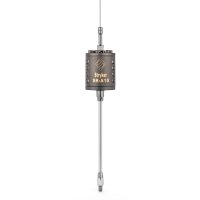
How do I tune Stryker SRA10 Antennas?
Check your SWR on channels 1, 20 and 40. If channel 40 is higher than one, remove the whip from the antenna, cut 1" off, then re-install and re-check your readings. Keep doing this until channels 1 and 40 have the same reading. For more detailed steps, check our guide here <a href="help/swr-cal-knob-what-is-it-for-cb-radio.php">SWR Tuning Guide</a>
How do I tune Stryker SRA10 Magnetic Antennas?
Check your SWR on channels 1, 20 and 40. If channel 40 is higher than one, remove the whip from the antenna, cut 1" off, then re-install and re-check your readings. Keep doing this until channels 1 and 40 have the same reading. For more detailed steps, check our guide here <a href="help/swr-cal-knob-what-is-it-for-cb-radio.php">SWR Tuning Guide</a>
What is an RCI 2950?
The ranger communications incorporated (RCI) 2950 series has been a 10 and 12 meter radio produced by Ranger USA for over 30 years.
How many watts is an RCI 2950?
The average AM carrier is between 2-12 watts. PeP modulation is an average of 45-50 watts PeP. SSB is usually between 35-50 watts depending on the generation.
How do I keep the channel I'm on after turning the radio off?
To keep any setting on the radio, including the backlight color, other menu options, and the channel you are on you need to save the options from the menu. To do this follow these steps:
1. Go to the channel you want
2. Press and release the menu/channel knob on the bottom left of the radio to enter the menu
3. Make any menu adjustments
4. Once completed, press and hold the same menu/channel button for a few seconds until you hear a long beep. Now the menu settings are saved and the radio will remember the channel after being turned off.
Does this radio have talkback?
Yes, you can enable talkback and adjust the talkback level within the menu
How do I adjust echo?
Hold BAND/TONE to toggle Set Echo Level and Time within the menu.
Does this work with ICOMs or Kenwoods?
No it does not
What is S.A.M.E. and why is it important?
S.A.M.E. (Specific Area Message Encoding) allows the WR400 to filter emergency alerts by location. Instead of sounding an alarm for every alert in a large broadcast area, the radio can be programmed to only notify you for alerts issued in your selected county or counties. This helps reduce unnecessary alarms while ensuring you receive critical warnings that apply directly to your area.
Will the radio still alert me if the power goes out?
Yes. The WR400 runs on standard AC power but also includes battery backup using 4 AA batteries (not included). If the power fails, the radio will continue to receive and broadcast alerts as long as batteries are installed.
Can I charge my phone with this radio if the power goes out?
Yes. The WR400 includes a USB output port that can be used to charge mobile devices during power outages or emergencies.
How do I change the frequency range on this radio?
You can change this radio's frequencies depending on the region your in by following these steps:
1. Hold P4 + FUNC key and turn on the radio
2. Hold the PTT button on the mic and using the channel knob set the radio to the following:
-- Mode 1 : US Dualband HAM 430-440 & 144-148 MHz
-- Mode 2: Expanded Mode: 400-490 & 136-174
-- Mode 3: EU Dualband HAM 430-440 & 144-146
Should I read a
Yes! If you measure continuity on most base station antennas, you will read a shorted connection between the center pin and ground. This is normal!
How do I know if my MXT500 has the updated software?
If you're serial number begins with 24 then you're in luck and already have the 8/24 updates. If not you can find the newest software and downloads here: <a href="https://midlandusa.com/pages/mxt-500-programming-firmware"> Midland MXT500 Programming Firmware</a>
What wire is positive and ground?
The wire with the dashed white line is positive, the other wire with no coloration is ground
Do I need a 12V power source for this meter?
This meter will function without any 12V power source, but if you want the display to light up, you need to connect the included power cord to a 12VDC power source
What is the correct band for CB in the US?
Select "EU" for the US frequencies. When set to EU, this radio will operate from 26.965 ~ 27.405, which corresponds to the same frequencies in the US.
What is the correct mode?
Make sure to set the mode to AM by default for the US. This radio has the option for FM mode as well, which is uncommonly used in the US.
Can this microphone be re-wired for 4pin radios?
No. The digimic is designed for 6-pin President (and similar) radios as these radios provide power to the microphone. 4 pin radios do not send power to the mic, and as such this microphone would not work on anything it's not designed for.
My faceplate is scratched?
The glass faceplate on the front of the radio has a protective film. Remove the film.
Do i use this radio on AM FM LSB SSB?
By default most CB'ers are using the AM mode.
What are the P Channels on this radio, and how do they work?
P Channels are 5 pre-programmed FM channels with built-in CTCSS/DCS privacy codes. They’re designed to let users with equipped President radios communicate easily without interference. As long as everyone is using radios with the same P Channels, you can talk without having to hear every signal that's sent out on that channel.
What does an IP67 rating mean?
An IP67 rating refers to a specific level of protection provided by an enclosure against dust and water ingress, according to the International Protection (IP) rating system.<br><br>
IP stands for "Ingress Protection."
The 6 indicates the level of protection against solid particles like dust. A rating of 6 means the enclosure is completely dust-tight] - <strong>no dust can enter.</strong><br><br>
The 7 indicates the level of protection against liquids, specifically water. A rating of 7 means the device can withstand temporary immersion in water. More specifically, it can be submerged in water up to 1 meter deep for up to 30 minutes without damage.
So, an IP67-rated device is fully protected against dust and can be submerged in water up to 1 meter for a short time, making it suitable for outdoor or rugged environments.
How do I test my radio's power ouput with this meter?
Flip the right switch into the PWR position and set the left switch based off of your power range. For your basic CB radio the 10 Watt position will do, or switch into the 100 watt scale if you're using more than 10 watts. Key down on your microphone without speaking to read your RF power (deadkey). Key the microphone and talk directly into the mic to check your modulation or swing wattage.
Display lights are dimming
This radio has a built in light sensor and will change the brightness of the lights depending on how bright the environment is.
My meter changes colors when I key up
The meter on this radio has a secondary transmit light to indicate you are keying your mic
How do I check my SWR using this meter?
From OPEK's Manual:<br><br>
1. Turn the transmitter of and disconnect the antenna coaxial cable at the output.<br><br>
2. Connect the SWR-3 “TRANS” connector to the transmitter output, and “ANT” to antenna connector. As short
cable equipped with male connectors on both ends will be required between the transmitter and the meter.<br><br>
3. Set the slide switch to “SWR” and “FWD”. Rotate the “SET & FS ADJ” counterclockwise to near minimum
position.<br><br>
4. Turn the transmitter on, rotate the “SET & FS ADJ” for full scale, “SET” position on meter.<br><br>
5. Next, set the slide switch FWD/REF to “REF” and read the meter scale. The meter will give the SWR reading
directly.<br><br>
6. A 1:1 ratio is the ideal match. Adjustments on the antenna system should be made so that the SWR is as low as
possible. A SWR of 2.0 is considered satisfactory, taking into account the line losses and slight mismatching.
The operator is referred to the numerous articles in radio magazines and books dealing with various proper
matching methods of different types of antennas. NEVER attempt to adjust the set to the antenna.<br><br>
7. The power required for the SWR bridge operation is dependent on the frequency; about 25 watts of 3.5 MHz, 15
watts at 7 MHz, and proportionately lower power at higher frequencies. If the transmitter power is not sufficient
and a full meter swing cannot be achieved, adjust the antenna system for the lowest possible swing at the “REF”
position of the slide switch.
How do I use the meter to read RF Power
From OPEK's Manual:<br><br>
1. Connect the SWR-3 “TRANS” connector to the transmitter output, and “ANT” to antenna connector.<br><br>
2. Set the slide switch (SWR, PWR) at POWER position, and set the range slide switch (FWD, REF) to either 10 watts
or 100 watts position, whichever is suitable.<br><br>
3. When the transmitter switch is on, the meter needle will deflect. Read the amount of deflection on the top scale.
If the range switch had been set to the 100 watt range, the value is multiplied by 10.<br><br>
4. For accurate power reading the SWR-3 should be used in circuits having SWR value of up to 1.5. The meter
accurately will decrease if the SWR value exceeds 1.5.<br><br>
5. Always have the meter switched off when removing this meter from the circuit.<br><br>
6. NEVER disconnect the “ANT” connector when transmitting. The abnormal voltage generated may damage the transmitter.
How do I use the SWR-3 as a field strength indicator?
This instrument is designed so that comparative RF field strength can be determined. A pair of diodes has been inserted in the circuit to rectify the RF energy picked up by the small antenna. Remove the instrument from the transmitter output circuit and restore the former transmitter antenna connections.<br><br>
1. Set the slide switch to “SWR” and “FWD”<br><br>
2. Fasten the bar antenna to the stud on the side of the case.<br><br>
3. Bring the SWR-3 in the vicinity of the transmitter of antenna system with the transmitter in operation. Be careful
that the pickup antenna does not come in contact with any metallic portion of the transmitter or antenna.<br><br>
4. The adjusting knob is rotated to obtain a convenient reading on the meter.<br><br>
5. After the aforementioned steps have been taken, any adjustments performed on the transmitter or antenna will
be reflected by an increase of decrease in the meter reading.
What's the advantage of the FM Mode?
Using FM (Frequency Modulation) mode for CB (Citizens Band) radios offers several advantages:
<br><br>1. <strong>Better Audio Quality</strong>: FM generally provides clearer and more consistent audio quality compared to AM (Amplitude Modulation), which is the traditional mode used in CB radios. This means clearer communication, especially in noisy environments.<br><br>
2. <strong>Less Susceptible to Interference</strong>: FM is less susceptible to interference from electrical noise and static, which can be common in urban and industrial areas. This allows for more reliable communication over longer distances.<br><br>
3. <strong>Narrower Bandwidth</strong>: FM transmissions occupy a narrower bandwidth compared to AM, allowing more channels to be allocated within the CB radio spectrum. This can reduce channel congestion and provide more options for communication.<br><br>
4. <strong>Suitable for Data Transmission</strong>: FM modulation is also suitable for transmitting data, which can be useful for certain applications such as telemetry or remote control.<br><br>
5. <strong>Less Power Consumption</strong>: FM transmitters typically consume less power compared to AM transmitters for the same range of communication. This can result in longer battery life for portable CB radios or reduced energy costs for fixed installations.<br><br>
6. <strong>Immune to the "Carrier Squelch" Issue</strong>: FM radios are not affected by the "carrier squelch" issue that can occur with AM radios, where weak signals may not trigger the squelch circuitry properly, leading to constant background noise. FM radios typically have better squelch performance.<br><br>
However, there are also some limitations and considerations when using FM mode for CB radios, such as potentially shorter range compared to AM under certain conditions and the requirement for more complex circuitry in both the radio transmitter and receiver.
Where is the owner's manual?
It's located in the carrying case behind a zipper.
Does this unit come with a USB cable?
Included in the carrying case is a USB-C to USB-C charging cable. This single cable can be used for the drop-in charger.
How does this meter get power?
You need to use at least a 12VDC 1A power source for this meter to function. In a vehicle, you can tap into any 12V power source. At home you need a separate power supply (sold separately).
How do you tune Silver Bullet CB antennas?
• For wide band performance, the SWR readings on Channel 1 and 40 should be equal with the lowest reading on Ch. 20. You must calibrate on Ch. 1 and then check the SWR. Repeat this step on Ch. 40.<br><br>
• If the SWR reading is higher on Ch. 40, the antenna needs to be shortened. Loosen the locking nut on the Silver Bullet tip and lower the tuning tip. Recheck the SWR and adjust the tuning tip as needed to achieve balanced readings on Ch. 1 and 40.<br><br>
• If the SWR reading is higher on Ch. 1, the antenna needs to be lengthened. Loosen the nut on the Silver Bullet tip and raise the tuning tip. Recheck the SWR and adjust the tuning tip as needed to achieve balanced readings on Ch. 1 and 40.
How do I unlock or tie off the clarifier?
Turn on the FIN setting in the Function menu, then press the FUNC key once to navigate to FINM.
How do I get the Talkback to work?
The Talkback function can be turned ON / OFF by pressing the Talkback control in and turning the control knob to the desired volume. If you hear a squeal the Talkback volume is too loud or the microphone is too close to the speaker.<br>
Its not uncommon to accidentally push the Talkback control in while making adjustments.
Why are the display lights not coming on?
The display lights can be toggled ON / OFF by pressing in the Dimmer control knob and adjusting the brightness.
Can I connect an external antenna?
Yes. The radio includes an external antenna input and even comes with a reel-type shortwave wire antenna.
What can i listen to with an ATS-909X2?
The ATS-909X2 lets you listen to much more than traditional AM and FM radio. Tune into international shortwave broadcasters, amateur (ham) radio operators using SSB, civil aviation communications, marine weather broadcasts, time signal stations, and longwave transmissions from around the world.
What does an IP54 rating mean?
An IP54 rating means the Alinco DJ-MD5XLT is designed to resist dust and water during everyday use. The first number (5) means dust is kept out well enough to protect the radio's internal components, while the second number (4) means it can withstand splashing water from any direction. It's a great choice for outdoor activities, job sites, and emergency communications, but it is not waterproof and should not be submerged.
What is DMR?
DMR stands for Digital Mobile Radio, a digital communication standard that provides clearer audio, better spectrum efficiency, and more advanced features than traditional analog FM. The Alinco DJ-MD5XLT supports both DMR and analog operation, allowing you to communicate on digital DMR systems while remaining compatible with many existing analog repeaters and radios. DMR also supports features like talk groups, private calls, text messaging, and improved battery life compared to analog-only operation.
How do I enable VFO mode?
Press and hold the channel knob to get into the menu, tap the knob to switch between menu options until you see SPAN, set SPAN to ON. Turn the radio off then on again, or key the microphone to save the value. Now when turning the channel knob you can fine tune the frequency in VFO mode.
What trucks does the CASP4 fit?
The CASP4 is compatible with Freightliner Cascadia P4 and P5 models (2018+)
What size antennas work the best?
For the best performance we recommend a quality, top-loaded antenna 5 foot or taller.
Can I use this on the driver and passenger sides?
Yes. The adjustable design allows installation on either mirror.
What trucks does the CASP4 fit?
The CASP4 is compatible with Freightliner Cascadia P4 and P5 models (2018+)
Can I use this on the driver and passenger sides?
Yes. The adjustable design allows installation on either mirror.
Still stuck? Our techs answer the phone.
We run these radios ourselves. Call 1-844-925-2688 (M–F 10–5 CST), or send a question and we will write back.