











AM RMS
TO PEP CONVERTER
Most power meters measure AM RMS. Most radio manufacturers print AM PEP on the box. This tool converts between the two so you can tell whether your radio is actually doing what the spec sheet claims.
Your meter and the box measure different things
A watt is a watt — what changes is when your meter samples the signal. AM radio sends a carrier that gets modulated up and down by your voice. RMS captures the average power over that modulation cycle. PEP captures the instantaneous peak power at the crest of the loudest part of your signal.
Both numbers describe the same radio correctly. They're just answering different questions. The spec sheet answers "what's the highest power this radio produces?" (PEP). Your meter answers "what's the average power going out?" (RMS). They're related by the shape of the modulation waveform.
The 2.67× rule
For AM at 100% symmetrical modulation, PEP equals 2.67× RMS. Here's where the number comes from:
At 100% modulation, RMS (average power) equals 1.5 × carrier, and PEP equals 4 × carrier. Divide PEP by RMS and you get 4 / 1.5 = 2.667. That's the textbook conversion this tool uses.
Real radios vary from this baseline. A conservatively modulated radio might show 2.4× or 2.5×. A radio with enhanced positive peaks — common in 10 meter export radios — can hit 3× to 4× or more, because positive modulation peaks exceed 100% while RMS stays near the theoretical average. If your measured numbers don't match the 2.67× rule exactly, that's your radio's specific modulation behavior — not a failure.
Quick reference
| AM RMS (meter reading) | AM PEP (box spec) | Typical Radio Class |
|---|---|---|
| 6 W | 16 W PEP |
Stock CB |
| 15 W | 40 W PEP |
Entry-level 10 meter radio |
| 37.5 W | 100 W PEP |
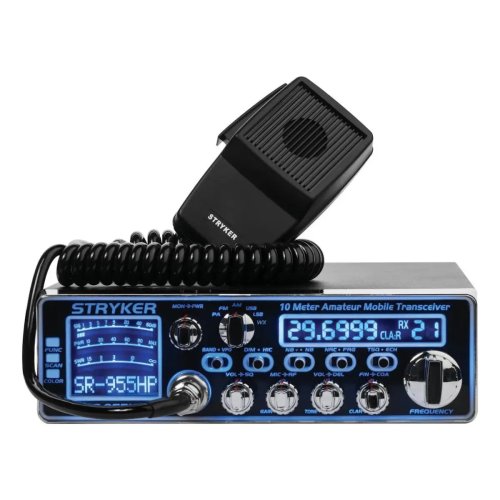
Stryker SR-955 class |
| 75 W | 200 W PEP |
High-powered Ranger class |
| 150 W | 400 W PEP |
Top-of-line Ranger class |
Why this matters. Customers call us regularly saying "my radio doesn't put out what the box claims." Most of the time, the radio is working correctly — they're just looking at an RMS meter reading and comparing it to a PEP spec. If the box says 100W PEP and your meter shows 37.5W while talking, that's the expected relationship, not a broken radio.
Getting a true PEP reading. To actually verify PEP, you need a peak-reading RF power meter with adequate peak-hold time. A quality power meter will give you more trustworthy readings than a cheap SWR/power combo. The Bird 43 with peak kit is the industry standard for CB repair shops, including ours.
The 2.67× conversion is a starting point. If you measure your specific radio with both an average meter and a peak meter and the ratio isn't exactly 2.67, that's normal. Use your radio's actual measured ratio for more accurate predictions.